Hayate Shinkansen
Bullet TrainThe Hayate Shinkansen is more than the setting for the novel’s encounters: its movement orders a sequence of decisions, delays, and revelations, carrying passengers toward Morioka while the meaning of their journey changes around them. Its route is marked not only by named stations but by the train’s slowing, waiting, curving, and departure. Those physical transitions give the narrative a visible measure of time, even as the people aboard struggle to understand what is happening.
Route and Setting
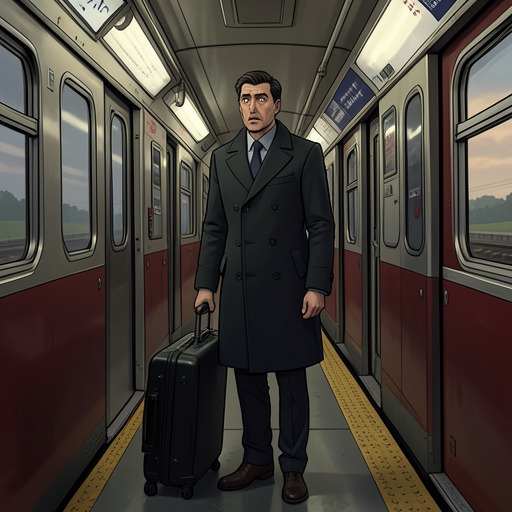
As the Hayate approaches Ichinoseki Station, the platform comes into view and begins sliding past as the train slows. Nanao adjusts his black-framed glasses and stands in front of the door, preparing to leave the schoolboy with Mr Suzuki for the journey onward to Morioka. The station is therefore a practical threshold: Nanao’s departure would alter who is responsible for the boy, while the train’s progress gives that decision an immediate deadline.
The exchange is unsettled from the beginning. Mr Suzuki describes himself as an exam-prep instructor, but his response does not clarify whether Nanao’s remark was meant for him or for the Prince. The Prince dismisses the ambiguity as meaningless, then calls after Nanao to ask whether he is really leaving. The train’s route toward Morioka is also tied to the Prince’s stated purpose: he had intended to inspect Minegishi there and use Kimura to test him. Now Kimura is out of action, barely breathing and lying across the floor beside two dead men. The destination remains fixed, but the plan that gave it meaning has already been disrupted.
A Moving Enclosure
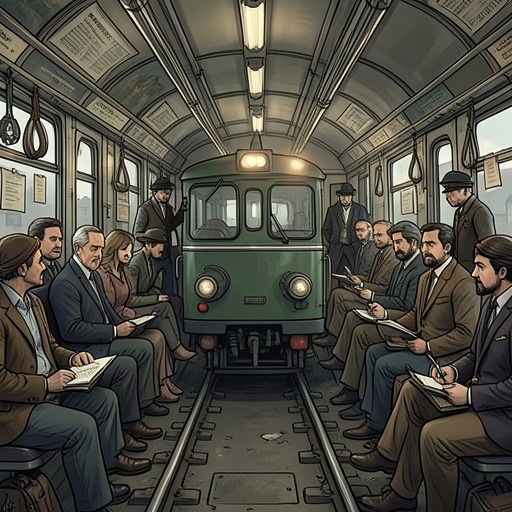
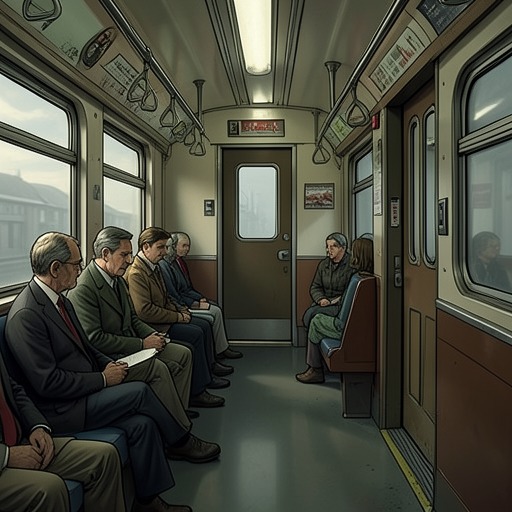
The train’s interior gathers people into proximity without giving them a shared understanding. During one tense pause, four people sit holding their breath as a phone vibrates. The sound seems to make everything else go quiet. Nanao reaches toward his own trouser pocket, only to discover that his phone is not the one ringing; the schoolboy opens his backpack and identifies the call as his. The small, ordinary device briefly takes control of the scene, directing everyone’s attention before its owner is known.
This moment makes the train feel less like neutral passage than a confined space in which attention can be redirected at any instant. Passengers cannot simply leave the unfolding encounter behind; their choices are shaped by the carriage, its doors, and the distance remaining to the next stop. Yet the same enclosure brings separate concerns together. The conversation about the boy and Nanao’s departure sits within the larger journey to Morioka, where the Prince expects to investigate Minegishi and where Kimura’s incapacitation has undermined his plans.
Stops, Pauses, and Motion
At Shin-Hanamaki Station, the Shinkansen remains beside the platform for a minute. The narration likens the pause to the train catching its breath; then it sets off again, and the landscape resumes its flow. The brief stop interrupts the onward movement without ending it. Its measured duration makes the train’s departure noticeable: the stillness is temporary, and the journey reasserts itself as soon as the train moves.
The description also gives the train a suggestive presence without removing its material role. It arrives, waits, and starts again, while the changing landscape registers its movement. The pause at Shin-Hanamaki is especially distinct from the suspenseful hush around the vibrating phone: one quiet is produced by people holding their breath, the other by a train momentarily stopped beside a platform. In each case, stillness is a short interval inside a larger passage, and what follows is a return to motion.
Arrival and Narrative Function
Near the end of the journey, the Shinkansen describes a gentle curve, displaying what the narration calls its grace and power one last time before the end of the line. An announcement about transfers accompanies the approach to that endpoint. The train’s curve is both a concrete movement and a change in narrative pace: after the onward journey and its tense encounters, the line of travel bends toward arrival. The transfer announcement makes the ending practical as well as dramatic, placing the passengers at a point where routes can diverge.
Kimura then returns the phone to the schoolboy and tells Akiko that the message on the ticker was correct: their grandson Wataru is safe. Akiko leans toward him, jubilant and seeking confirmation. The train has carried them to the moment when anxious uncertainty gives way to news of Wataru’s safety; the Prince opens his mouth to speak, leaving the scene poised for another exchange. The Shinkansen pulls into Morioka Station, completing the journey that had framed the Prince’s investigation and Nanao’s attempted handover.
Across these episodes, the Hayate Shinkansen links movement with provisional knowledge. A platform slides past, a phone sounds in a suspended silence, a station pause gives way to flowing scenery, and the final curve precedes both transfer instructions and news about Wataru. The train does not resolve the conflicts among its passengers, but its route supplies their encounters with sequence and pressure. Morioka is at once a destination reached and the point at which the plans formed aboard the train must confront what has changed during the ride.